Posts Tagged ‘call center’

Call center requiests handled by a team of professionals

Sunday, June 1st, 2008

Call Center is a computerized office where large volume of customer request and queries are handled by a team of professionals. The office is operated and controlled by a company to administer all the product support and online queries through the customers. Various offshore deal and debt collection is also made here in these call centers. In addition to all the customer support and services, call center is also meant for receiving and delivering various fax, e-mails, and letters to and from the dealers or consumers.

Various wings and sections of customer service representatives is appointed in a call center, each of which pertaining to a particular product of the company. The employee has to deal with each and every queries put on by the consumer regarding the performance and functionality of the product. Call center is an extensive open help desk where each call center agents are provided with computer, head-set and telephone, connected to the main telecom switch of the company. Each of the computers can either be independently operated or worked on under a common computer network including main frame computer and local area network. All the voice and data pathways are linked through a computer telephony integration which keeps a track record of all the incoming and outgoing calls from the office.

Main motive of call centers is to interact with the customers and deal with all the utility regarding the catalogue firms and customer support for software and hardware products of the company. Some of the call centers even work on offshore business and deal with the consumers abroad. Some companies even operate a call center office to carry on the internal functions more specifically and smoothly within the nation. Those call centers may either be in the form of help desk or a sales support.

A call center can be viewed as a operational network in the form of Que. This queuing network is so assumed with same type of customers and statically identical servers arranged in a Queue form of network. This queuing theory is the key to the over all work force planning and management. A track record of the entire performance index is measured with the help of this queuing network. How many calls can a employee attend, frequency of call rates, efficiency of the employee to sort out with the queries are few of the work flow sections which has to be managed through this queuing network.

Queuing model also works on the qualitative and quantitative insight of the company. Based on the performance index of queuing model it could be decided that the call center should be more qualitative driven or the quantitative driven. The one which could be more beneficial for the company is chosen. Queuing model can also be used for planning and operating skill- based routing of calls. Based on the multi-type customers and multi talent skilled professionals the work force can accordingly be distributed.

A scorecard of the performance of each and every employee is maintained under the queue model network of the call centers. An operational research on shift- structure of the employee, forecasting of calls and the detailed analysis of customers impatience is maintained with this queuing network of call center.

Call Center Services

Wednesday, May 21st, 2008

Call center is a computer operated centralized office that is being administered and operated by companies to provide a proper support and information inquiries with the customers. Various companies do setup their call centers to even deal with their clients abroad and maintain a proper communication channel between them. Call centers may said to be a kind of help desk where number of employee do sit around in office with a computer, head-set and a telephone to provide in-time support to the consumer of the company products.

A call center is very often operated in an open work place with number of employees working together 24/7 in shifts to provide all time support to consumer world-wide. Calls from consumers and clients from all over the world are being entertained through these employees. Outgoing call is also being made for telemarketing, clientele and debt collection. There are several wings in call centers, each of which is imparted with a specific task. A section is defined for collective handling of e-mails, fax, letters and other hard-copies of important documents. Depending on the product range of the company, number of sections are defined and being operated by the trained employee. Those employee are first imparted with in-depth knowledge of all the good and bad aspects of the product he is about to deal with. Customers may put on variety of questions which they have to sort out with patience.

Each of the computers installed in a call center can either be independently operated or may work under a common computer network, including mainframes, microcomputers and LANs. Hence all the computers have a common pathway so as to maintain a collective track record of all the customer details and respective performance of the employees. Computer network are interconnected by star topology or sometime bus topology as per the requirement. Voice data and the pathways are linked through new technology, termed as computer telephony integration.

Most of the call centers do maintain a key performance indicator (KPI) as a financial or non financial metrics to measure overall progress rate of the company. The overall management of the business is traced and conclusive result is taken out with this key performance indicator. The present state and the prescribed course of action is accurately being judged by this key performance indicator.

Call centers are centralized to enhance company’s performance and cut the extra costs due to unnecessary work flow. A streamlines and uniform services is provided to consumers of the company. Latest computer technology is installed to monitor quality control and performance activities of the workers. Many call centers do adopt workforce management software that generates an automated schedule to meet an anticipated staffing level needs. As per the software, a scorecard is maintained that guides through a proper work flow in every section depending on the wrap-up time, average call duration, number of calls in queue etc. A close view to the consumers with different languages other than English is also given importance by hiring employee with variable language skill

The Importance of Performance Based Call Center Management

Sunday, April 27th, 2008

Metrics should be used to employ performance based call center management. With metrics, measuring the performance of call centers is made easier.

It is not easy managing a call center at all. A lot of people assume that it is easy to manage a call center, but it is not at all. This is because there are so many factors to consider here. However, it is very important to find effective ways and means to manage your call center, to ensure and facilitate its growth and success. So, how do you see your call center? How is its performance? If you have difficulty answering this question, then you should consider employing performance based call center management. This way, you can keep track of the performance of your call center representatives, to ensure quality service and growth for the establishment itself.

But how exactly can you keep track of the performance of every call center representative comprising your workforce? The answer to this is call center metrics. It is so hard to quantify the performance of every call center representative because there are so many factors to consider here. For instance, just how productive are the representatives at the job? Do they really satisfy the needs of the customers they handle? Do they give quality solutions to the problems presented by the customers? Are they able to come up with these solutions fast? And what about the average handling time? How long does the average phone call last for each representative? Attendance is also another factor to consider here. These are just some of the factors to consider when it comes to developing call center metrics. Surely there are more factors that have not been mentioned yet.

One important thing to remember about developing call center metrics is that less is actually better. Yes, there are many factors to consider; this is a point that has long been established already. However, when a large number of metrics are used to evaluate performance, then there is more room for extraneous factors. These extraneous factors just might make it all the more difficult to get down to the bottom of measuring performance. In fact, it is actually recommended to use just five metrics for your call center balanced scorecard. Most call centers nowadays use more than twenty-five metrics for their scorecard. Imagine how many extraneous factors can tamper with the real information that you should be measuring here! As much as possible, just limit your metrics to five. Choose the ones that are relevant to call center performance at its very core. The five metrics that are strongly recommended include Customer Satisfaction, Call Cost, First Call Resolution, Agent Efficiency or Utilization, and Overall Call Center Performance.

More often than not, you would find that one of the five metrics mentioned would actually be related to other metrics on the list as well. For instance, the metric Customer Satisfaction is actually influenced by a number of factors, which include the other recommended five metrics as well. When you want to quantify customer satisfaction, you would have to look at First Call Resolution, Call Quality, Speed of Answer, and the like. This is another reason why it is better to use only a few metrics when you want to employ performance based call center management. Different call centers in the industry might use different sets of metrics. This is understandable because the metrics here should be in line with corporate goals and objectives. Since these differ, then you can expect the metrics to differ as well.

How to Improve Call Center Income with Balanced Scorecard Implementation

Sunday, April 20th, 2008

You can improve call center income with balanced scorecard implementation. The key here is to use relevant KPIs for your balanced scorecard.

For the most part, call centers all over the world are indeed earning modest income. The large and stable ones even earn millions of dollars in a single month of operations. The knowledge and experience gained over the years have certainly contributed to the successful operations of these call centers. But then again, experience and knowledge are not the only things these call centers have in common. They also have what is known as a balanced scorecard. Yes, it is indeed easy to improve call center income with balanced scorecard implementation.

Call centers provide customer service for the clients of large companies. These companies are of such magnitude that they cannot handle the provision of customer support of all their clients. Should they strive to handle this on their own, they might end up not giving the quality customer support their clients deserve. This is then the reason why these large companies delegate the task of providing their clients customer support to call centers. The typical call center would then have different accounts to handle, and they would then employ the different departments to handle the different issues the clients would be calling about. Because there are different accounts to handle, then performance here would be measured variedly as well. This can make measuring performance all the more complicated. Thus, there is indeed a need to employ a balanced scorecard to monitor the performance of the call center as a whole. From constant monitoring, there would certainly be improvement in terms of performance. And where there’s enhanced performance, there will definitely be improvement in terms of income as well.

It is actually a bit difficult to develop the key performance indicators or KPIs to be included on the balanced scorecard. This is because the KPIs here have to be in quantifiable form so that they can be measured accurately. Fortunately, in the call center context, there are many factors that are quantifiable, and these can be used as KPIs as well. In fact, these are just some of the performance measures being used by the lot of today’s call centers.

* Average Talk Time (ATT) or mean conversation time

* Average Handling Time (AHT) or mean dealing time

* Service Level (SL%) or number of calls answered during a limited time period

* Delay experienced by customers while waiting in queue

* Percentage of calls bearing resolved issues

* Percentage of calls bearing unresolved issues

* Number of calls handled by representatives per hour

* Customer satisfaction

These are just some of the KPIs that many call centers are using nowadays to measure the performance of the establishments as a whole. The main thing to remember here is that there should be just a limited number of KPIs employed. As tempting as it is to use many KPIs, this is actually not advisable. This is because if you use many KPIs, there would be more room for extraneous variables, which can influence the accuracy of measurement here. Thus, it would be better to use the KPIs that have relevance to the operations of call centers. With just these KPIs, you can then improve call center income with balanced scorecard implementation.

Metrics Than Helps to Manage Call Center

Sunday, April 13th, 2008

Applying metrics than helps to manage call centre may be more advantageous to come up with immediate resolutions.

Metrics than helps to manage call center – what are they and what benefits can they bring to the call center industry?

Helping the call center can be done by hiring analysts and experts to check the performance of call center agents and the environment of the working place. Analysts can be from independent or hired employees of a call center business. Outside help can provide the industry with sound business strategy, which can be necessary to meet its objectives and defined goals.

However, in managing a call center, help from experts may be costly or even ineffective at a certain degree. In call center management, one of the things that managers of contact centers can use to measure efficiency and efficacy of the business functions is the metric system. One of the metrics for measuring the performance of the call center agents, as well as the managers, supervisors, and other employees with direct relation to the business and its functions is the KPI.

KPI is perhaps one of the popular metrics, either financial or non-financial, for measuring the activities that may be too complex to quantify, but are still quantifiable. This metric tool, known as key performance indicator, can be used to assess factors that are crucial to the functions and strategies of businesses. The factors which may be seen as key performance indicators may be critical in meeting the objectives of a business enterprise, in this case, the call centre business.

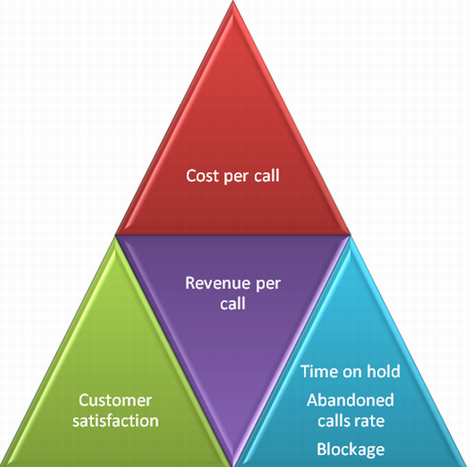
The factors that may be crucial to a call center business may include the proficiency and competency of employees, particularly agents, the average response time of calls, the rate of abandoned calls, the cost per call, and customer satisfaction.

The things that need to be quantified and measured can be kept at a minimum number. As they say, less is more. Thus, the factors that can be considered key performance indicators should only be those that have direct connection and response to the performance of a call centre business.

KPI of call centers can be used not only to measure the performance, but also to help identify strengths and weaknesses in the work setting. The performance metric can, likewise, be utilized to determine and diagnose the problems and drivers of performance gaps.

Moreover, KPI may also be applied in call center businesses to come up with prescribed actions for performance enhancement. In some cases, it can be benchmarked to industry peers so other players of the call center industry can come up with ideas for performance measurement. Further, the use of KPI can help a call center business in establishing the performance goals for the entire organization.

The balanced scorecard is another metric that can be used in call center management to assess the performance in the call center agent level and other departments in the call center business. It is also a performance measurement that can assess quantifiable and complex activities that have importance in the call center business. Balanced scorecard software is a tool that can help call center managers in determining the performance level and rate in the business.

Assessing performance involves measures than helps to manage call center. Other tools and methods proven to be effective can also be applied in call center management.

Measure and Control Call Center Performance

Sunday, March 23rd, 2008

To measure and control call center performance, you will need to gauge the rate at which it is performing. These measures can show you how.

Simple call centers evolving into multi-channel contact centers do not just happen in a whiff. Adding or upgrading technologies and expanding staff skills are important following the addition of new applications such as e-mail and web chat. Also, it is necessary to determine which performance measurements should be used for this new kind of operation.

Performance measures that are associated with service are said to be the most important. These measures may work for both call and contact centers or change depending on the type of transaction.

An example of call center performance measure is blockage. This accessibility measure indicates the rate of customers at which they cannot access the center at a specific time due to inadequate network facilities. Measures that indicate blockage or busy signals by occurrences of “busy trunk lines” are utilized by most call centers. Failure of a blockage goal enables a center to meet its rate of answer goal by blocking excess calls. It may appear as if the call center is doing a good job at managing call queues, but it can actually have a negative impact on customer accessibility.

The call center should also carefully know how much facilities are needed for email server capacity and bandwidth to avoid huge quantities of emails from overloading the system. The same goes for the number of lines that support fax services, which must be adequate enough to allow reasonable blockage.

Another way to measure call center performance is through abandon rate. Call centers usually gauge the number and rate of abandons because both correlate in terms of revenues and retention. However, it has to be noted that the abandon rate is not completely under the control of the call center. While the average waiting time in queue can affect abandons, there are a lot of other factors affecting this number, among which include availability of service alternatives, time of day, caller tolerance and many others. Also, while the abandon rate measure is not commonly related with email interactions, it applies, however, to web chat communications.

Self-service availability and utilization is also an important accessibility measure and is commonly gauged by self-service menu points and methodology, demographic group or time of day.

On the other hand, the most common measure for speed of answer in a call center is the service level. Meanwhile, the longest delay in queue (LDQ) is another gauge for speed of answer, which is used to indicate when it is necessary for immediate staffing reactions. LDQ is categorized into two namely longest delay to answer and longest delay to abandon. The former is the delay for a customer’s transaction to be finally handled by the agent and the latter is delay for a customer to abandon the contact.

These measures usually gauge the speed of call center performance. There are still many other performance measures applicable to call centers, both in-bound and multi-channel. These may be used to measure individual agent performance or overall call center operations. In all cases, these measures should be used to determine performance excellence as well as gaps that need improvement with different adjustments.

Crucial Metrics that Measure Call Center Performance

Sunday, January 27th, 2008

Identifying the metrics or key performance indicators (KPI) that really matters is crucial for managers to measure call center performance.  These metrics should not be entirely agent-centric. Rather, customer satisfaction and loyalty should also be taken into account.

Many experts now consider the important role that key performance indicators (KPIs) play in measuring call center performance. Along with this, they recognize the need to narrow down KPIs to the metrics that really matters.

Traditionally, performance management systems in call centers used to really on simple measurements like handling times, talk times, wrap times, and idle times as the primary criteria for evaluating agent efficiency. With certain technologies like predictive dialers and automatic call distribution (ACD) systems, it was very easy to access, compile and interpret data on agent-centric efficiency metrics that have been mentioned previously.

While these information do provide call center managers accurate information about how their agents perform, they do not necessarily dwell on overall customer experience. Likewise, these efficiency measures do not take into account the performance of a call center in line with its corporate goals.

The emergence of new technologies that enable call centers to obtain customer interaction analysis has benefited call center managers by enabling them to run their usual operations and at the same time, determine how the entire organization vis a vis their corporate goals. Unlike traditional call center efficiency reports, these new technologies focus on improving the overall productivity of call centers in conjunction with improving customer satisfaction ratings.

Call center management are faced with the dilemma of balancing productivity goals of the entire organization and the improvement of call center customer experience.  Managers, more often than not, hire additional agents especially during peak times when frequency of inbound calls is expected to rise. At the same time, they can not hire as many agents as they want because agent salaries account for almost 70% of call center expenses.

Along with this balancing dilemma, it is also a challenge for call center managers not to rely more on agent-centric measurements as indicators of success. Doing so tends to disregard other KPIs such as customer satisfaction and loyalty which should have been considered as primary critical success factors. Experts on call centers, upon thorough analysis, now find the need for call center managers to identify metrics that will help them identify which among the agents are able to meet quantitative goals at the same time, provide top-notch customer service.

By obtaining data on talk time and first call resolution (FCR), it becomes easier to identify which among the agents excel in solving customer problems within the least amount of time.

Most call center technologies can easily provide information of up to 25 metrics at a time. While these can be used as indicators of agent and call center efficiency, experts recommend that only 5 metrics ideally measures overall call center performance. These five KPIs are cost per call, customer satisfaction, first contact resolution (FCR) rate, agent utilization and aggregate call performance. These metrics are based on the Pareto or 80/20 principle which states that from these 5 indicators, 80% of performance measurement and call center management values is obtained. These success factors, likewise, determine the Balanced Score of a call center which quantifies the aggregate efficiency of a call center over time.

How to Boost Call Center Performance

Monday, January 21st, 2008

Your task as a call center manager is to make sure call center performance is high as revenue would depend on it. There are several ways on how you can ensure this.

Managing a call center business is never an easy task. There is always pressure because there is an evident and abrupt need to monitor performance. Of all the types of businesses, call centers are different because operations heavily rely on the quality of call services the personnel are providing, In other words, call centers are different in that revenues rely on how persuasive and effective the staff are in handling telephone calls and marketing products and services via the telephone.

As a call center manager, your challenge is how to manage a pool of people who are of different personalities and demographics. There is a need to guide and manage these people accordingly and effectively as to ensure their performances are great and yielding to productive results. Here are several practical guidelines that are designed to help call center managers bolster call center performance.

1. Choose the best and most reliable personnel for the job. With this recommendation is the reminder that good call center management starts the moment you hire staff for your business. Hiring the right people is imperative because the business would heavily rely on them. Choose people who are good at carrying conversations, adept in the industry and very much motivated to work within a team.

2. Before allowing the hired personnel to go live or conduct call transactions, make sure they are properly and adequately trained. This is the reason why it is a requirement that any call center company should conduct and sponsor a special training program for its newly hired personnel. Be careful and be strategic when developing, designing and devising such training efforts. Make sure the series of seminars to be held would touch on key issues and concerns regarding overall attitude, listening skills, scripting, conversing, politeness, patience, persuasion, referral and effective speaking practices.

3. Call center operations basically run scripts. There should be a standard flow of conversation. Usually, a protocol or script is provided to personnel to guide them on how to handle a call or a conversation. When writing that script, be particularly attentive and open minded to know which lines would be polite, convincing and noteworthy.

4. Establish a good and effective system in monitoring team performance regularly. It would be advisable if you would be able to monitor how the team is faring on a daily, weekly and monthly basis. Doing so would help you immediately find out if there would be modifications needed for the flow or if your people are doing what is appropriate. Adopting a good call center performance metrics for personnel would also be of great help since there is a need to monitor the performance of each of the team members.

5. Build enthusiasm in the workplace. As much as possible, do not pressure the team to do good. Let them enjoy the workplace so that they would be more enthusiastic in reaching targets and goals. As a manager, you could do a lot in ensuing that the workplace turns really conducive for a pleasurable work.

If you are able to follow such tips, expect that in no time, call center performance would be significantly boosted in no time.

Why Call Center Metrics is Fundamental to Success

Thursday, January 10th, 2008

For a call center to determine just how efficient it is at its chosen field, call center metrics should then be developed.

You just cannot discount the fact that call centers today are amongst the most successful businesses all over the world. And it is because of this fact alone that has caught the attention of many investors worldwide. Now, you just might be one of the many aspiring entrepreneurs who are considering delving into the call center business. But seriously, operating and manning a call center is not as easy as it may seem. By looking at the huge call centers that are operating today, you cannot help but wonder just what do they have? What is that certain gusto behind their success? If there is something that successful call centers have in common, aside from the superb quality they get from the agents that they hire, it is metrics. Yes, call center metrics.

In fact, no call center can ever do without call center metrics. This is because these are the metrics, the indicators themselves, which show you in quantifiable terms just how good, or bad, your call center is performing at the moment. If you own a call center, and you ask yourself how your center is doing, just how can you answer that question? Do you refer to the yearly revenue your call center is garnering? Would that answer your question satisfactorily? With the many aspects underlying the success of call centers, revenue alone does not really answer the question. This is why call center metrics are very much needed in the setting.

So, in developing call center metrics, you have to consider the need to develop KPI’s, or key performance indicators. These are the indicators of performance that you need to place into the context of your call center, the markers, to be more specific. Bear in mind that there is actually a need to keep the number of metrics to be used at a moderate amount. If you use too many metrics, then too much time and effort would be exerted in analyzing performance. When you use too few metrics, then the evaluation would be too broad as well. In the call center setting, it is actually recommended to use just 5 metrics. The commonly used ones include: Customer Satisfaction, Call Cost, First Call Resolution, Agent Efficiency, and Overall Call Center Performance.

In developing call center metrics, you will surely notice how some of the metrics are related to other metrics. For instance, customer satisfaction is related to first call resolution, as well as call quality. So, what constitutes customer satisfaction, to be exact? Let us then look at first call resolution and call quality as individual metrics. If you were the customer, what determines call quality for you? Wouldn’t it be first call resolution? If the agent is unable to resolve the issue you are calling about in his first attempt, then this would not spell out that much quality for you. Thus, first call resolution constitutes a bigger part of customer satisfaction, when compared to call quality.

There is indeed a need to be as organized as possible when developing call center metrics. This way, you are sure to have an objective perspective when choosing which metrics to use and plot on your scorecard. With the scorecard in tow, you can then proceed to measure just how efficient and successful your call center is when it comes to performance.

Call Center Metrics

Friday, November 30th, 2007

Call Center Balanced Scorecard focuses on measuring and controlling of Call Center performance.

 Call Center Metrics

This Scorecard contains indicators that are highly specific for measuring the performance of phone support services. The four group of indicators provides manager with balanced analysis over call-center performance.

Call Center Metrics

  • The Financial perspective - Calls revenue, costs, conversion. Includes indicators that helps to measure financial aspects of call-center performance. Indicators within this category are: Revenue per successful call, Cost per call, Conversion rate.
  • Internal Process perspective - Calls handling and processing. This group of indicators helps to measure Average call-handling time, Number of Sales attempts, Caller’s Segmentation, Support Service Availability.
  • Coaching in call-center perspective allows to find out if education and growth processes are organized well. This perspective includes such indicators as Coaching time, Supervisor responsibilities, Coaching methods.
  • Another group of indicators is Calls quality, this group includes such indicators as Response time quality, Customer loose rate, First-call resolution, Save rate.

Get Balanced Scorecard Metrics

Please, download and try trial version of HR Scorecard before placing order.