Posts Tagged ‘customer service’

Customer Service Performance Tips

Monday, March 17th, 2008

These customer service performance tips can give your business the edge in today’s fiercely tough competition.

Competition nowadays has become even more cutthroat. Customer expectations are getting higher and there is more price comparing, among many factors that need to be considered in order to get a leg up in the competition. Competitors are doing all they can to keep their customers and gain new ones as well. It’s a simple fact that presents a cold, hard truth: Satisfy your customers and you keep them. If you can’t, then you lose them.

So how do you make sure you re not lagging far behind in this fiercely competitive environment? It’s that simple. Good, quality customer service. By putting value to your customer’s needs, having the ability to create strong customer relationships and finding tailor fit solutions to customer problems, you can ensure the success, if not the survival of your business. In whatever facet of doing business with customers, it is important to give them a higher quality of service than those of your competitors. You need to treat every customer as a positive experience and make the customer feel that s/he is highly valued in your business as well. By giving your customers a positive and pleasurable experience, they will keep coming back for more of your products and services.

Customers have also become more demanding today. There are a number of ways that you can do to win them over. A very important thing you should always keep in mind is to put your customers first. Focus on them and pay close attention to what they really need. Know and understand what their needs, concerns, expectations and priorities really are. This way, you go beyond more than just merely serving them but also demonstrating that you care.

Also, whether you admit it or don’t, you should keep in mind that your business exists because you are in sales. You are being constantly evaluated by your customers so each time you interact with them, you should always show concern and care for them. Remember that whatever you say or do can affect your relationship with the customer and the reputation of your business as well. By constantly giving them exceptional service, you build goodwill with your customers and strengthen your business’s sustainability and credibility as well.

To ensure a culture of customer service excellence in your company, get everyone in your team involved in establishing office guidelines and policies that require each one to maintain core values that are important to both the customers and everyone in your business.

Choose effective words or phrases that demonstrate care and professionalism in your everyday interaction with customers. Also, establish a system for measuring customer care. These include number of customer complaints, retention rates and satisfaction rates. Know which measures are important and commit to improve them.

It is only right to treat your staff properly if you want them to treat customers the same too. You cannot expect them to be ‘happy to serve’ your customers if they are not pleased with how you are treating them. Let your people feel that they are working with, and not for you. This will encourage true cooperation so that your business can achieve customer service excellence.

Tips for the Manager: How to Upgrade Customer Service Performance

Sunday, February 10th, 2008

Leading the customer service team to attaining a commendable customer service performance is full of challenges. There are several simple ways on how this could be achieved.

There is always a heavy demand for a good customer service performance. On the business front, a reliable customer service unit is one of the main factors that help bring about a healthy revenue flow to the company. When there is an excellent customer service, it is logical that there would be a sustained volume of loyal patrons and customers. In the end, this would lead to higher sales and a steady flow of income for the company.

If as a manager, you are aiming for a high customer service performance, experts advice that you target providing an extraordinary service to customers. Clients are sources of income for your unit so make sure they are well served and well treated by your team. Here are seven of the most effective tips that would help you guide the customer service team towards a better and more sustained performance.

1. Be extraordinary. Your team might have different ideas and concepts of being extraordinary. It would be better if you would set a standard concept for the word and be clear that the concept set for the team is only applicable to team efforts. This way, everyone would agree to one standard definition for the word and eventually have a consensus of how being extraordinary could be applied to real life situations particularly in the customer service operations.

2. Allow team members to approach you when they are not sure about any provision regarding the customer service operations. Because of this, make your self highly approachable and accessible most of the time. That means, you should always be around especially during occasions when problems arise.

3. Motivate the team to be extraordinary. To do that, orient and brief the team to further and more clearly understand what there is to understand. This way, they would be better equipped into do better in what they do. As a manager, you should also respect individuality and allow each team members to retain their individuality. Advocate sincerity, as it would help better establish rapport between customer service representatives and clients.

4. Share helpful information. If you have encountered new knowledge that may be of great help to operations, immediately share this to everyone in the team. Doing so would help you ensure that everyone is well informed. Eventually, this would translate to better customer service.

5. Share commitment. As a manager, of course, you are expected to be highly committed to your job. You are an effective manager if you would be able to make your team as committed as you are. Motivate the team to reach goals and targets and improve the unit’s overall performance.

6. Be patient. Significant increases in sales do not happen overnight. Be patient to wait for sometime until target results and outcomes are met.

7. Be prepared for challenges and react to such setbacks accordingly. Who says attaining high levels of customer service performance is that easy? A team would succeed on collective efforts aside from having a highly effective manager that handles the team.

Identifying Key Customer Service KPI

Wednesday, December 12th, 2007

Agent and call center efficiency should be measured based on crucial customer service KPI as these indicators will help evaluate the performance of both agents and call centers vis a vis company goals.  

Key performance indicators (KPIs) are measurements that can be quantified. These critical success factors vary depending on the nature of an organization. In the case of call centers, customer service KPIs are crucial indicators of overall call center performance.

It is undeniable that many call center managers are unaware about the crucial role that KPIs play in the management of call centers. Instead, they focus more on agent statistics such as average speed of answer and abandonment rate which industry experts consider as unimportant metrics. In contrast, KPIs are given importance for their ability to monitor and predict performance as well as identify, diagnose and resolve call center performance problems.

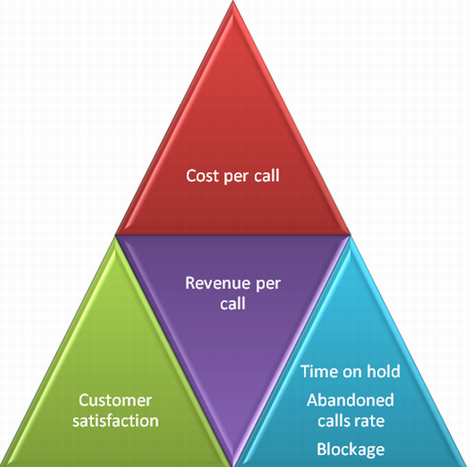
The average customer service call center employ technologies that can give them information access to more than 25 metrics. While these can assist managers in evaluating agent performance and utilization, some of these are unnecessary that they need to be narrowed down to those metrics that really matter. Call center experts identify five metrics that they consider most important. These metrics include cost per call, customer satisfaction, first contact resolution (FCR) rate, agent utilization and aggregate call center performance.

Cost and quality should be among the essential metrics as call centers exist to provide the best quality services at the lowest possible cost. In call centers, the most important cost metric is cost per contact. On the other hand, the best metric for quality of services is customer satisfaction. This explains why cost per call and customer satisfaction are two of the metrics included in the five essential call center KPIs as identified by experts.

First contact resolution (FCR) or the number of contact resolved during the initial contact with customer, is another metric that should be given importance as statistics show that call centers with low FCR rates also had low customer satisfaction ratings. While customer satisfaction could also be influenced by other variables such as Average Speed of Answer (ASA), and Handle Time, FCR is considered to be the single biggest driver of customer satisfaction. Agent utilization is also among the essential KPIs of call centers as it is the best measure of labor efficiency. Cost per call is decreased if agent utilization is high. Salaries and incentives of call center agents comprise more than half of call center expenses.

Reducing call per cost is the only leverage available to call centers to counter the effects of labor costs. Agent utilization, however, should not be kept at extremely high rates as this may result to employee burn out which in turn, leads to turnover. Lastly, aggregate call center performance is an essential metric as this is an indicator if the call center is improving or declining in terms of performance. The Balanced Score is established as the single score that measures the overall performance of a call center. This metric, when monitored over a period of time, will show stakeholders exactly how the company is doing.

There are other common metrics that were not included in the list of essential 5 customer service KPIs like call abandonment rate and average speed of call. While these can measure agent efficiency, they are less important and less effective as critical success factors.

Improving Customer Service Performance to Increase Customer Satisfaction

Wednesday, December 5th, 2007

Various call centers have recognized the need to improve their customer service performance to increase customer satisfaction. In line with this, necessary steps would have to be made to provide high quality services to clients.

Call centers are created to provide marketing and product support to certain products and services. These centers are used by major businesses like utility companies, mail order catalogue firms and banks as a means of directly interacting with their customers. Since they are primarily created to benefit the customers, customer service performance is considered an important indicator of call center efficiency.

A call center is classified based on the kind of calls that its agents make. Outbound call centers are those whose agents place calls to potential customers of a certain product or service. Inbound call centers, on the other hand, receive calls from customers. These people call to ask questions about a product or service, report a malfunction, or ask for assistance on how to use a product or avail of a service. In line with the efficient handling of calls, call center agents are usually organized into a multi-tier support system.

In this operation model, the first tier is generally composed of agents who direct calls to the appropriate department and who provides general directory information. Calls are forwarded to second-tier agents if the customers insist on more assistance. Usually, it is at this stage that most calls are resolved. If a customer issue is still not resolved at this stage, calls are then forwarded to the third-tier which are primarily comprised of product engineers and highly skilled technical support staff.

Call center managers are faced with the challenge of balancing requirements of cost effectiveness and the provision of quality services to customers. Managements of call centers need to hire sufficient staff to answer the inbound calls from customers. They also need to ensure that with the number of agents that they have, they would be able to provide quality services to their clients. Managers often use demand estimation and telecommunication forecasting techniques to determine the level of staff that is required at a certain time. Salaries of agents make up the bulk of call center expenses which is why managers should see to it that agents are effectively utilized.

To achieve this, performance management systems are set up in call centers to measure how agents perform. Different technologies are also employed to effectively manage the large volume of calls that call centers usually manage. These technologies allow calls to be queued and processed so that agents are kept as productive throughout their shift. Some of these technologies include predictive dialing, automatic call distribution (ACD), computer telephony integration (CTI), and customer interaction management (CIM) solutions.

While call centers pay attention to agent statistics such as average talk time, average handling time and service levels, call center management now gives weight on customer satisfaction. For instance, metrics such as First Call Resolution (FCR) rates is now among the most used as statistics show that FCR is directly related to customer satisfaction. In fact, the most effective way of improving the customer service performance of a call center is by increasing its FCR rates. To improve FCR, agent training, agent incentives and investments in skills improvement should be made.