Posts Tagged ‘helpdesk’

Scrutinizing the Role of Helpdesk in Customer Management

Sunday, September 7th, 2008

It is worth one’s time in the call center, or business process outsourcing industry to look up the role of helpdesk in customer management.

The definition of the word helpdesk in the new world of business process outsourcing is a little more specific compared to its traditional meaning, and with the new meaning comes its new uses. There are many known uses of the helpdesk software used in call centers. One of the main uses of helpdesks is that they direct the customer service needs of clients, both online and offline. This role of helpdesk in customer management makes it a very handy tool considering call centers of late are now situated offshore.

There are many advantages in using helpdesks in your company. In fact, the very advantages we are going to discuss are the actual roles helpdesks do. If you are having a hard time creating new strategies to go over difficult situations in your company, the use of helpdesk can greatly help. This is because helpdesks can automatically run certain processes involving customer service issues and can do multi-tasking. If you are thinking of many things to be able to create the ultimate strategy, unburdening yourself with certain multi-tasking functions and a few more customer service issues allows you to be able to achieve your goal faster.

Also, the presence of helpdesks makes things easier on the side of your customers. Instead of having to call a representative over the phone and wait for several minutes in order to speak with one, they can just access your online support (run by your helpdesk software) and they are spared of having to waste their time and the possibility of getting irate.

Simultaneously, this is one time management efficiency for your company since certain customers, after having gone through your online support run by your helpdesks, will only need to contact your representatives if their issues are unresolved by your online support. The workload of your employees on the front line is lessened, giving you a more relaxed and less-stressed team to handle customers.

The chain reaction helpdesks start at the increase of your first level employees’ efficiency and will continue and impact those handling the teams in your company. These team leaders will be able to function and do more of their tasks because of the minimal supervision needed for them to do to maintain high performance of their respective teams. And from the supervisor or team leader’s standpoint, it can move up to the managers, senior managers, and directors. And before you know it, the chain reaction has reached its end and it gets to you, the owner of the company.

Another role of helpdesk in customer management is that it magnifies existing and upcoming problems waving your company’s way. For existing problems, it presents the situation in such an orderly manner that you will not have to think very hard just to be able to come up with solutions. As for those problems still moving onwards to get to your company, you can put preventive measures early on to be sure the problem will not land in your company, and be another topic you would waste time in conferences and meetings.

Measuring ROI of Helpdesk

Saturday, March 29th, 2008

Performance measurement can be a tool and a process for measuring ROI of helpdesk. Quantity may not only be involved to assess the ROI, for quality should also be considered.

There are factors to consider in measuring ROI of helpdesk. But first, it is worth to know what a help desk is and how it functions.

Help desk is an assistance and information resource that can provide resolutions to problems concerning IT products. In other words, it helps people with problems in computer and related products by relaying troubleshooting transactions via telecommunication means. Companies, mostly corporations, have help desk support to provide assistance to their customers via a website, e-mail, and/or toll-free number. Though companies can employ hired help desk agents, this function has usually been outsourced to contractors that offer the differentiated service.

Help desk does not only exist in the information technology world. The traditional help desk support can be found in businesses and educational institutions. In companies, help desk can provide information assistance, not only to their clients and customers, but as well as the employees. Some companies have their in-house help desk catering only for their employees.

The function of help desk has also reached into the realm of educational campuses. Some schools have a curriculum where students availing of that class can perform help desk functions.

Perhaps, the most popular help desk of these contemporary times can be seen in call centers.

Help desks are deemed helpful in maintaining the business and customer relationships. Because of its nearness to customers, it is important then for people handling the help desk to be properly trained. The performance of a help desk agent must be within the means of the company’s mission and defined goals and objectives.

In measuring the ROI of help desk, there are critical factors that must be taken into account. Perhaps the foremost is the performance of the help desk agent.

Assessing the performance of the help desk agent or agents is important in determining the return of investment for employing the customer-support function. In measuring the performance of help desk agents and the ROI of help desk, performance metrics can be used.

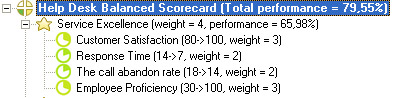
Perhaps, the most popular metric for activities that are complex to quantify and measure is the KPI or key performance indicator. The KPI in helpdesk ROI may include the performance of the help desk agent. Other factors to be considered would include employee proficiency, response time, call abandon rate, and customer satisfaction. These factors can be measured by recording the call activities of help desk agents and customers or by tracking system known as incident tracking system for logging the processes and activities taken place on the onset of calls.

The balanced scorecard is another tool that can be applied for assessing the total performance and measuring ROI of helpdesk.

The balanced scorecard is a metric for measuring the activities of enterprises and assessing their value and results in line with the enterprises’ objectives. It is a performance measurement framework that can be utilized by businesses to measure quantifiable and abstract factors that are vital to a business.

There can be variation in the contents and elements of the balanced scorecard used by one company to another. Individuals tasked to measure the performance may have used traditional means of assessing the total performance rate. However, in these modern times, the use of software has become increasingly common. Measuring the performance using the common or customized software can be helpful for businesses aiming to fully practice its strategies and for gaining insights of the things that must be done as responses to certain problems or concerns.

Measuring ROI of helpdesk can be complex. One company may use different performance measurements to derive the ROI of its helpdesk functions.

The Fundamentals on Helpdesk Management Tips

Monday, February 25th, 2008

To ensure the productivity of helpdesk in call centers, there are actually a lot of certain helpdesk management tips that you can consider.

The helpdesk actually exists to provide much needed assistance in the overall operations of call centers. When you are in the business of call centers, there are actually two sets of customers that you need to consider, which are the internal and the external customers. If only the budget would allow, then all needs brought about by these customers can be answered to right away. Unfortunately, such is not the case, so there should be some sort of balance to be set when it comes to helpdesk management.

The first of many helpdesk management tips is the auditing of the center’s current practices. It is important to do this before you do engage in certain changes for your processes, as needed. Each and every detail should be audited. However, you should pay attention to customer care and other support services offered by your helpdesk.

The second is to develop what is known as service level management. This is done by clearly outlining what the different services that your helpdesk offers. IT provisions should also be monitored, since there would inevitably be broader requirements when it comes to handling the business. Once this service level management is established, then things should flow more smoothly.

The third step is to reevaluate costs entailed. The total costs in providing these services should be pegged, first and foremost. After such a figure is established, then you should proceed to determine just how much each and every call received and made costs, as well as the costs each call entails in order for particular issues to be resolved. Identify which calls are easily resolved because these are actually the ones that are cheaper. These are the calls that do not generate that much income for your helpdesk. This does not mean it would be better to have calls on problems and issues that are harder to resolve, just because these generate more income. Rather, effective helpdesk management would do whatever it takes to provide self-help tips, so that clients would no longer have to contact customer service representatives just to solve trivial problems, say, resetting passwords for instance.

The fourth step is to make sure you have exactly the right mix when it comes to hiring the people for the job. Techies may have the needed expertise to handle difficult calls, but they just might not have the necessary customer service skills needed in handling the call itself. Similarly, customer-savvy representatives may be too lax when handling difficult calls. Thus, the perfect mix should be achieved here. It is actually better to get customer-savvy representatives than to get techies. This is because technical skills can be easily taught and learned, whereas interpersonal and communication skills are inherent.

Lastly, you should demand quality support from your suppliers. This is in accordance to your rights to high-end support, so do not worry about appearing demanding. Technical evaluations should be made from time to time, so that you can be sure that your call center would be as efficient as it should be. Returns of investment would then be made more smoothly if you keep in mind these helpdesk management tips.

Making the Most from Helpdesk Efficiency Secrets

Sunday, February 17th, 2008

There are certain helpdesk efficiency secrets that can be used in ensuring the overall performance of helpdesks all over the world. Customer satisfaction is the underlying concept in these secrets.

The advent of technology brings about so many advantages and benefits that are resting on the palms of our hands. But not everything brought about by such technologies are positive. There are certain technical problems and issues that gizmos and gadgets just cannot do without. And this does not pertain to just gizmos and gadgets alone! There are so many services that warrant a call or two to helpdesks, just for technical support or assistance. Thus, in order for helpdesk agents to provide the quality service their customers are entitled to, then a certain level of efficiency should be achieved on their part as well. And this is where the importance of knowing certain helpdesk efficiency secrets sets in.

When you are discussing helpdesk efficiency, then you should keep in mind the underlying concept of customer satisfaction. This is the primary aim of all helpdesk agents. Now, there are certain things that can help any helpdesk agent in ensuring customer satisfaction. One of these is the establishment of a scorecard. This scorecard actually helps in quantifying aspects that determine helpdesk performance. Here lies the concepts that have been used for some time now, and these are the number of calls answered, as well as the length of the calls that have been answered. The basic premise here is the more calls the agent receives, then the more people he is able to help. To be able to entertain more calls, then the handling time for each call should also be as short as possible. This is the quantitative side in helpdesk performance.

There is also a qualitative side that you just cannot do without. The number and length of calls are not enough to ensure customer satisfaction. In fact, customers do not really care how long their calls would be, so as long as the issue or the problem is resolved. Thus, this should also be included in the equation, to ensure helpdesk efficiency.

For these to be strongly implemented, then the needs of your customers should be evaluated and outlined as clearly as possible. This way, you can easily determine the benchmarks needed in the whole process. The ability to foresee the needs of your customers is vital here. As helpdesk agents, you should know the features of the products you are handling inside and out, so that you will have a glimpse of the possible glitches and complaints your customers might have. You also have to remember that not all of your customers have the technical knowledge that is needed in operating your products efficiently. As helpdesk agents, you have to be patient when handling these matters. Remember that your job is to satisfy each and every customer. Keep this in mind, especially during the times when handling calls becomes difficult.

Lastly, the proficiency and productivity of helpdesk agents should be plotted on the scorecard as well. You have to make sure that the helpdesk agents you hire are as productive as they come. This way, customer satisfaction is easier to achieve. Thus, you should monitor the performance of each of your agents. You should check the call abandon rates of your agents for this aspect. Call abandon here actually means that the agent himself did not bother to take a call that has been routed to his line. This is a strong indication of irresponsibility. Thus, helpdesk agents with high call abandon rates should be constantly monitored.

Help Desk metrics

Friday, November 30th, 2007

Help Desk metrics focus on measuring customer service performance.

 Help Desk Metrics

This metric focuses on more specific details than Customer Relationship metrics providing more indicators for evaluation of customer support service.

Help Desk Metrics

Help Desk indicators are grouped into fours categories:

  • Service Excellence. This group contains four customer service specific indicators: Customer Satisfaction, Response Time, The call abandon rate, Employee Proficiency.
  • Program Excellence. This group helps to evaluate how good are solutions that customer service provide, indicators for this group are: Call Volume, Solution Accuracy, Reliability of Predefined Solutions, Tracking Accuracy.
  • Performance Excellence. Helps to estimate overall performance of customer service, include such indicators as First Time Settlement, Resolution Excellence, Resolution Time, Agent Commitment.
  • Quantitative Control. This group of indicators give a quality control over help desk performance, use indicators: Number of calls, Time controller, Opened tickets, Closed tickets.

Get Balanced Scorecard Metrics

Please, download and try trial version of HR Scorecard before placing order.